I'd actually forgotten that I'd posted a blog entry to start May off, so I was about to apologize for just now acknowledging the month had arrived, but it's been slamming me and beyond classes and my syllabi I barely can keep up with what day it is, let alone month. I thought this week was going to be slower, but it's been just as rough, but June is, thankfully, just around the corner....
Amidst all the reading, I have attended a few events at the university, all of which have been edifying in different ways. Starting backwards, tonight I went to hear the musician
Paulinho Garcia present a short (1 1/2 hour) tour of
Brazil. Truthfully, as all who know me will readily acknowledge, anything having to do with Brazil gladdens me immensely, and this didn't fail in that regard. The interactive performance felt like the best way to end a busy week. Garcia, a native of
Belo Horizonte and 3-decade long resident in the US, was introduced by my great colleage
Ana Thomé-Williams (above at right, with Garcia) also from Brazil, who had also helpfully created a slideshow featuring not only a map of Brazil but featuring song authors, titles, and lyrics, to which we could all sing along with Garcia. And sing people did as Garcia walked us through the
samba (giving us information on its origins in
Bahia and before that the
Congo region, and word's
Bantu etymology), then several different
sertanejo (from the
sertão, the harsh scrubland interior or backlands of the northeast) forms, and then the
choro and
chorinho, then a
caipira (another type of folk song--and the source of the word, on through
bossa nova. Tracing it via songs and musicians, he sang (beautifully, touchingly) Ari
Barroso's "Aquarela do Brasil," Luiz Gonzaga's "Asa Branca," Tom Jobim's "Andança," Pixinguinha's "Lamento," Zequinho de Abreu's "Tico-Tico no Fubá" (one of the earliest Brazilian songs to achieve fame in the US, and which made
Carmen Miranda famous),
Pixinguinha's "
Carinhoso" (so achingly moving),
Renato Teixeira's "Romaria" (which Ana graciously led us through in chorus),
Tom Jobim's and
Vinícius de Moraes's "
Eu sei que vou te amar," Jobim's and Vinícius's "
Chega de Saudade" (from
Marcel Ophuls's Orfeu negro/Black Orpheus),
João Bosco's and
Aldir Blanc's fairly contemporary
"Coisa Feita" (with its strong
Afro-Brazilian storyline), and finally, to end the event, Ana and Garcia sang the always stirring Carnaval melody,
"Tristeza," a snippet of which I captured on camera. Afterwards I chatted briefly with Garcia, who was explaining the ins and outs of Brazil to some undergraduates and other attendees, and I ran into a former student, from my earliest days at the university, who was doing really well. I also spoke with a young math student from Belo Horizonte, who suggested I tell a friend now conducting research in Niterói, just across the Guanabara Bay from Rio, about the Institute of Pure and Applied Mathematics that sits between Rio's Botanical Garden and its Tijuca Forest. How on earth could you get any work done in such a remarkable setting? I'd like to find out.
Exactly before the Brazilian musical event, which constituted what felt almost like the second half of a Cartesian exercise, I attended a lecture by
Eduardo Cadava (in the yellow shirt, with
Sam Weber (at left) who teaches English and many other subjects at
Princeton. Professor Cadava gave a rich, truly absorbing talk entitled "
Marx Before Literature," in which he sought to explore, among many questions, why Marx so often turn not just to literary language, but to literature. This tour, intellectually demanding in the best way, ranged over any number of theorists (
Benjamin, Blanchot, etc.) and literary figures (
Cervantes, Shakespeare, and Roque Dalton, among others), in order to rethink productively Marx's relationship to literature and literature's relationship to Marx. Or, to put it another way, that there could be no Marx before literature, and we could not understand literature before Marx. Cadava's reading of "before" involved, if I may venture to characterize it so, an almost phenomenological relationship (before in temporal, spatial, affective, etc. terms), an "encounter," as he put it at the end of the talk. Among the many notes I took, some stand out, and all, if rightly transcribed, should be ascribed to Cadava: that at moments of revolution, Marx said, "a person becomes lyrical"; that when he first went to college, as he confessed to his father, he was drawn to "lyric poetry"; that his return to poetry occurs in his letter withdrawing from it, which he stages in a literary fashion; Marx's memorials to literature constitute the "entirety of his corpus"; his work is a kind of and form of "mourning for literature"; that in their critique of the
young Hegelians, Marx and
Engels wrote the offenders "into" their own
Quixote, as it were; that
Sub-Commandante Marcos, leader of the
Zapatistas, noted to
Gabriel García Márquez that
Don Quixotewas one of the best books of political theory, followed by
Hamlet and
Macbeth; that literature "names the event of absolute freedom"; and that resources from revolution "come not from the present but from the future." Of course there was so much more, with a propulsive, compelling argumentative throughline that left me thinking as I raced over to the other event; I shall have to return to my notes, and to Cadava's work, and to Marx and, of course, though I never leave it, literature itself.
Last night, I went to see
UCLA professor
Mark McGurl (at right, at the lectern) whose recent study historicizing MFA programs and their effects on American literature,
The Program Era: Postwar Fiction and the Rise of Creative Writing (Harvard University Press, 2009), I'd noted on this blog before. I can only say that his talk readied my brain for Cadava's. Titled "On the Future of Literary Institutions," it represented excerpts from a larger current work dealing with posthumanism, literature and culture, among other themes, and leapt off from Wai-Chee Dimock's critical book
Through Other Continents, which seeks to rethink scholarly understanding of work via another scale than the current historicist models, or historically materialist ones, which is to say, according to what Dimock calls "deep time," or scientific and other larger, longer paradigms. As with Cadava's talk I don't want to wrongly summarize McGurl's, but it was provocative in the best way, and after roving through the issue of "big historicism" and citing Quentin Meillassoux's concept of "ancestrality," which I'd never heard before, McGurl focused specifically on the problems of vastness, the horror of getting lost in time, not through privation but through "troubling plenitude," and ways in which the horror genre in particular had interrogated and dramatized these fears. He then spoke about the reciprocal relationship between the fictions of
H. P. Lovecraft, with their desire, as in the "Call of Cthulhu" (which I taught last spring), to address the issue of scalar instability and all that that indexed (the social, political, cultural, racial-ethnic, gendered, sexual, etc.), and
David Foster Wallace's Infinite Jest and his work on infinity,
Everything and More. McGurl argued that while Lovecraft was "attacking institutions from the outside," Wallace, as the product of the sorts of institutions to which Lovecraft could not gain entry, "was attacking them from within," while also conservationally (as opposed, say, to conservatively), defending them against neoliberalism, in part by allowing them a scaled down, containable temporality and scope, and by dramatizing their necessity
in his plots. He went on to note how last summer, after Wallace's suicide, readers created a community,
Infinite Summer, around reading Wallace's book, creating the sort of "connectedness" that, McGurl suggested earlier, these vaster paradigms and scales, also created, beyond the scope of families, more obvious affiliations, and so forth. This led me to ask a question about
Andy Warhol's A and
Kenneth Goldsmith's durational texts,
such as
The Weather, particularly in terms of the way that both celebrate--to put it simply--plenitude, vastness, a lack of authorial control and of the very institutions, down to genre itself, that would contain them, and yet how, interestingly enough to me, both have come to constitute "institutions," one a kind of genius of proliferating art forms and concepts, the other the impresario of "conceptual writing" itself. I'm not sure I fully grasped McGurl's answer, though he did relate both works (and their authors) to strategies of the avant-garde, but I remain curious about how, especially in the case of Goldsmith, one might think about this issue of ancestrality, particularly if one were to carry the concept of his text through to its logical end, which is to say, to record, over an (infinite) time span, of extended duration, weather reports from a particular signal. Would this not bear out, in terms of people connecting through the text itself, its relations to and in discourse, an example of ancestrality in practice? I made a note to return to McGurl's great study when I have a break of extended sort, but also to dip into Wallace again and, if I can bear him in anything but tiny doses, the often repellant Lovecraft.


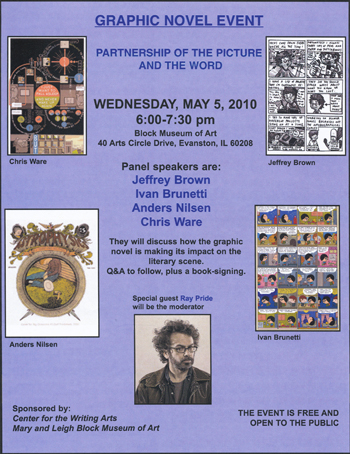
And finally, two nights ago, I went to a public conversation sponsored by the university's
Center for Writing Arts, entitled "
Partnership of the Picture and the Word," that featured four quite highly regarded comics artists/graphic novelists:
Chris Ware, Ivan Brunetti, Jeffrey Brown, and
Anders Nilsen (r-l above,
Ray Pride at far left) I was familiar with the work of all but Nilsen, and had even suggested Ware as a possible visitor a few years back. Film editor and writer Ray Pride
conducted the conversation, inving all four artists to spell the audience about their work, working methods, ideas about art and their own artistic practices, and more. I've periodically read Brown's work (I've used a snippet of it for a class I've taught) and regular follow Ware, but I think this was the first time I've seen either live, or several graphic artists conversing with each other, for that matter. One of the elements of their conversation I found most enlightening was when they spoke about
writing in pictures, or, as Ware put it, "making pictures" versus, as sometimes is assumed, a process parallel with cinema, which he characterized as "taking pictures." Each talked about his influences, how they developed stories, their publishing experiences, and the changing appreciation for graphic art and novels today. I was glad to see so many people turn out, and am now interested in how a conversation between someone working primarily in a graphic format, someone still primarily using text (the majority of fiction and creative nonfiction writers, playwrights, and poets), and someone bridging the two, might turn out. I'd also love to see what they'd say about the new digital formats in relation to their work; with Chris Ware in particular, what might a page on an iPad look like, and could it be even more dynamic--in 3 dimensions as opposed to 2, than it already is?